
Breakdown voltage (BDV) test is a primary laboratory method used to evaluate the real electrical withstand capability of insulating oil under controlled high-voltage stress. Unlike indirect indicators of oil condition, this test directly determines the voltage level at which a liquid dielectric loses its insulating properties and becomes electrically conductive. In high-voltage equipment, where operating stresses approach the physical limits of insulation systems, the breakdown voltage (BDV) test provides an objective and quantifiable assessment of oil integrity.
The Role of Insulating Oil in High-Voltage Equipment
Insulating oil is not a passive filler inside transformers and other high-voltage apparatus. It performs two life-sustaining functions simultaneously: electrical insulation and thermal management. Inside a power transformer, copper windings and laminated steel cores are completely immersed in oil. This oil electrically separates live components from each other and from grounded metallic structures while also transporting heat away from active parts.
Without adequate dielectric strength, even a momentary overvoltage can initiate internal arcing. Without sufficient cooling capability, localized overheating accelerates the aging of solid insulation, leading to irreversible damage.
Dual Function Explained: Insulation and Heat Dissipation
From an electrical standpoint, transformer oil acts as a liquid dielectric with very high resistance to current flow. It fills microscopic voids between conductors and solid insulation, suppressing partial discharges and preventing arc formation. The dielectric strength of the oil determines how much electric stress it can tolerate before a conductive channel forms.
Thermally, the oil absorbs heat generated by copper losses and magnetic losses, transporting it by natural or forced convection toward radiators or cooling surfaces. Any degradation of oil quality-especially contamination by moisture or particles-simultaneously weakens both insulation and cooling efficiency. This interdependence is why the breakdown voltage (BDV) test is regarded as a frontline diagnostic tool rather than a secondary laboratory check.
Breakdown Voltage (BDV) Test Explained
The breakdown voltage (BDV) test measures the actual voltage at which an insulating oil fails electrically under standardized conditions. Dielectric strength is an inherent material property, while breakdown voltage is the measurable point of failure within a defined electrode geometry and spacing.
A useful analogy is a dam holding back water. The height of the dam represents dielectric strength, while the water level represents applied voltage. Breakdown voltage is the precise level at which the water overtops the dam. Contaminants such as moisture, fibers, or metallic particles effectively lower the dam height, causing failure at much lower stress levels. The breakdown voltage (BDV) test captures this failure point with high repeatability.
Why High Breakdown Voltage Is Non-Negotiable
In operating transformers, oil gaps of only a few tenths of an inch must withstand voltage differences of tens of kilovolts. If the measured BDV drops below acceptable limits, even routine switching events or lightning-induced surges can exceed the oil’s withstand capability.
The consequences of internal breakdown are severe: arc energy decomposes oil, generates combustible gases, damages windings, and may result in fire or explosion. The replacement cost of large power transformers often reaches several million dollars, excluding outage-related losses. Regular breakdown voltage (BDV) test routines are therefore essential for both safety and asset management.
Standardized Procedure of the Breakdown Voltage (BDV) Test
The accuracy of the breakdown voltage (BDV) test depends entirely on procedural discipline. Oil sampling must avoid atmospheric moisture and particulate contamination. Samples are typically collected in clean, dry glass bottles and filled slowly to prevent air entrainment.
Testing is performed in a dedicated measuring cell equipped with precisely machined electrodes. Common electrode gaps include approximately 0.1 inches (ASTM D877) and 0.098 inches or 0.039 inches (ASTM D1816 variants), while IEC 60156 specifies a 0.098-inch gap with spherical electrodes. Voltage is increased at a controlled rate, typically between 0.8 and 4 kV per second, until an electrical breakdown occurs.
The test is repeated multiple times-most commonly six breakdowns-and the final result is calculated as the arithmetic mean. This approach minimizes random dispersion caused by particle distribution within the oil.
Modern Automated BDV Testers
Modern BDV testing equipment eliminates operator-dependent variability through full automation. Voltage rise rate, breakdown detection, electrode stirring, timing, and result recording are controlled by microprocessor-based systems. Automated disconnection within microseconds protects both the operator and the equipment, while integrated data storage supports long-term trend analysis.
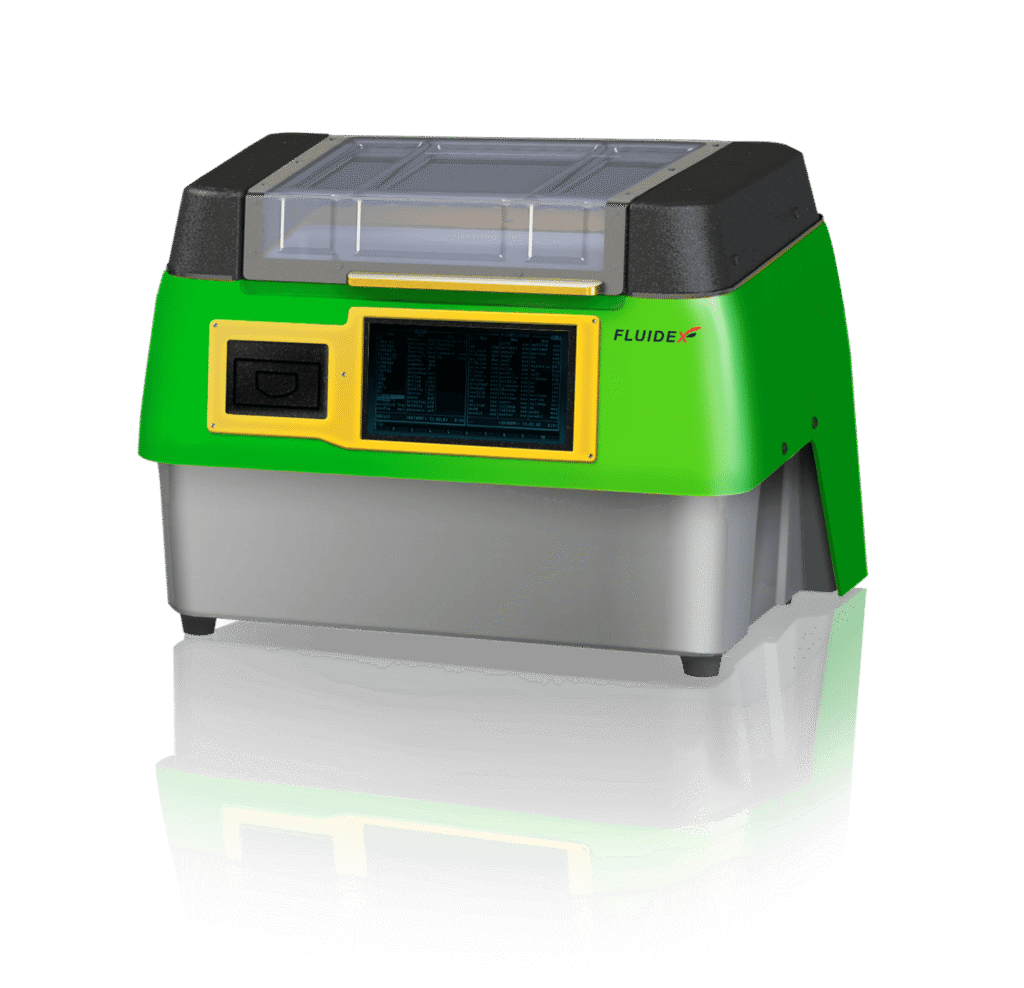
This is where Fluidex FLD 75T Oil Breakdown Voltage Tester and Fluidex FLD 90T Oil Breakdown Voltage Tester provide decisive advantages.
Fluidex FLD 75T Oil Breakdown Voltage Tester
The Fluidex FLD 75T Oil Breakdown Voltage Tester is designed for precise dielectric strength measurement of transformer oil and other insulating fluids in compliance with IEC 60156, ASTM D877, and ASTM D1816. The unit delivers a sinusoidal AC test voltage of up to 75 kV, ensuring compatibility with a wide range of laboratory and field applications.
The rechargeable battery and compact enclosure measures roughly 20 × 12 × 13 inches, with a total weight of about 66 pounds, making the device suitable for both laboratory benches and on-site testing.
An internal printer and USB interface allow immediate documentation and seamless data transfer for report generation, trend analysis, and database integration.
Fluidex FLD 90T Oil Breakdown Voltage Tester
For applications requiring higher test voltages, the Fluidex FLD 90T Oil Breakdown Voltage Tester extends performance up to 90 kV while maintaining full compliance with IEC 60156, ASTM D877, and ASTM D1816. Like the FLD 75T, it is fully automated and supports both standard and user-defined test sequences.
The electrical architecture mirrors that of the FLD 75T, including sinusoidal output, ±1% voltage measurement accuracy, adjustable voltage rise rates from 0.5 to 10 kV per second, and ultra-fast disconnection within approximately 4 microseconds after breakdown detection.
With identical physical dimensions of approximately 20 × 12 × 13 inches and a weight of 66 pounds, the FLD 90T integrates easily into existing workflows while offering increased voltage capability for demanding insulation diagnostics.
BDV Testing as Part of Predictive Maintenance Strategy
The true value of the breakdown voltage (BDV) test emerges when results are trended over time. Gradual declines in BDV often indicate moisture ingress, aging paper insulation, or contamination, while sudden drops signal acute faults requiring immediate attention.
By integrating automated testers such as the Fluidex FLD 75T and FLD 90T into routine maintenance programs, operators transition from reactive responses to predictive asset management. This approach reduces unplanned outages, extends transformer service life, and significantly lowers total ownership costs.
