
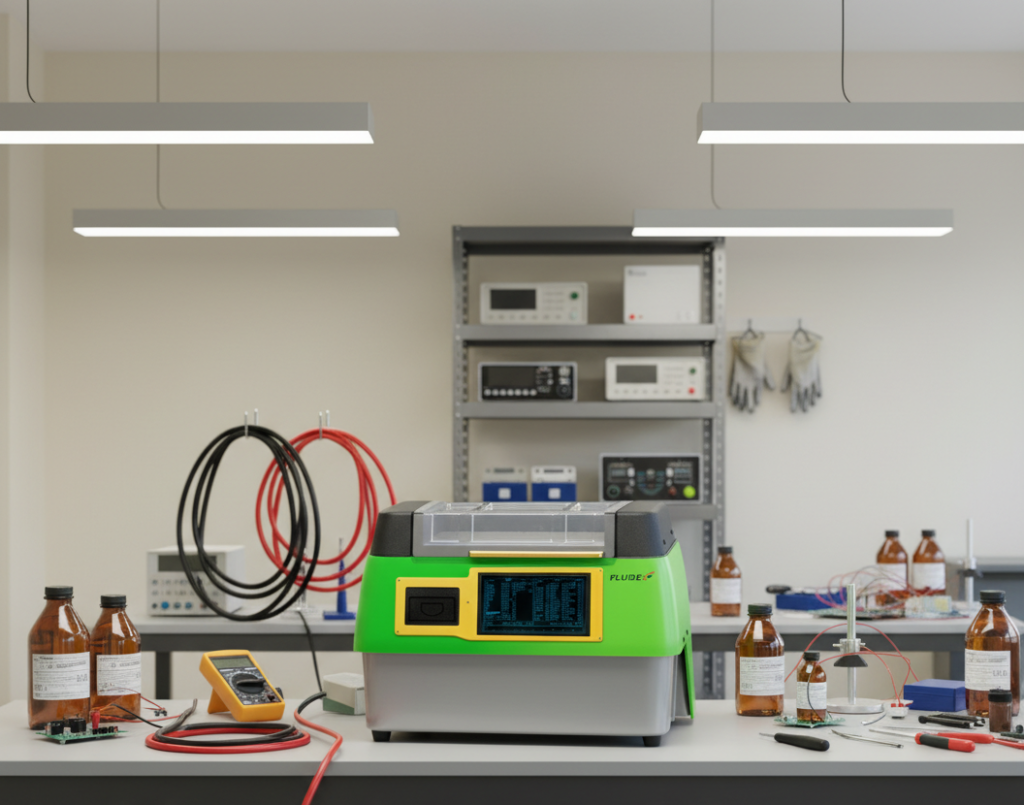
Fluidex BDV Tester is a standardized electrical diagnostic tool used to directly evaluate the dielectric strength of transformer oil and other insulating liquids under controlled laboratory or field conditions. Unlike indirect analytical methods, the breakdown voltage provides an immediate and practical indication of an oil’s ability to withstand electric stress without insulation failure. The test simulates real operating conditions by applying a continuously rising AC voltage across a fixed electrode gap immersed in the oil sample until electrical breakdown occurs.
This method is widely applied in power transformers, high-voltage switchgear, circuit breakers, and capacitive equipment, where insulating oil plays in both electrical insulation and thermal management. A decrease in BDV value is a clear operational signal of contamination by moisture, suspended particles, or degradation by-products, all of which significantly increase the probability of partial discharges, internal arcing, and long-term insulation damage. For this reason, the breakdown voltage testing is considered a core element of routine condition monitoring and maintenance decision-making for high-voltage assets.
Inevitable Degradation of Insulation Oil
In an ideal scenario, insulating oil would retain its properties indefinitely. In real operating conditions, however, oil is continuously exposed to destructive factors that gradually reduce its effectiveness.
Operating temperatures-often exceeding 176°F to 194°F (80–90°C) in power transformers-accelerate oxidation reactions. Oxygen dissolved in oil or present in the headspace reacts with hydrocarbon molecules, forming acids, sludge, and polar compounds. These by-products corrode metallic components, attack cellulose insulation, and restrict heat transfer by forming deposits on internal surfaces.
Moisture is the most aggressive enemy of dielectric strength. Water can enter equipment through leaking seals, during maintenance, or as a by-product of cellulose insulation aging. Even a few parts per million (ppm) of water can reduce BDV by more than 50%. Due to its polarity, water aligns under an electric field, creating conductive paths that drastically lower breakdown voltage-an effect clearly revealed by a Fluidex BDV Tester test.
Metal wear debris, carbon particles, cellulose fibers, and oxidation sludge may remain suspended in oil. Under high electric stress, these particles align and form conductive bridges between electrodes, effectively shortening the insulation path. When combined with moisture, their destructive impact becomes even more severe.
Physics of Electrical Breakdown in Insulating Liquids
Electrical breakdown in liquids is a complex, multi-stage process. Pure insulating oil is a poor electrical conductor. However, contaminants radically alter its behavior.
Under an increasing electric field, microscopic water droplets elongate and migrate toward the electrodes. Solid particles are drawn into regions of highest field intensity. At a critical voltage, these elements connect, forming a fragile conductive channel across the electrode gap. Initial current flow heats the channel, vaporizing oil and creating a gas bubble. Since gas has far lower dielectric strength than oil, the process rapidly escalates into a full electrical arc. The voltage at which this occurs is recorded as the breakdown voltage during the Fluidex BDV Tester test.
Breakdown Voltage (BDV) Testers: Unified Fluidex Testing Solution
Modern breakdown voltage (BDV) test accuracy depends not only on the test method itself, but also on the precision, safety, and automation level of the testing equipment. Fluidex offers a unified engineering approach to BDV testing through its high-performance oil breakdown voltage testers designed for transformer oil and other insulating fluids.
The FLD 75T Fluidex BDV Tester and FLD 90TFluidex BDV Tester are fully automated instruments developed in compliance with IEC 60156, ASTM D877, and ASTM D1816 standards. Both testers operate on the same measurement principle and software architecture, differing primarily in maximum test voltage capability: up to 75 kV for the FLD 75T and up to 90 kV for the FLD 90T. This allows users to select the appropriate model based on voltage class, application requirements, and testing margins.
The testers automatically execute standard-compliant test sequences as well as custom, user-defined procedures configured through the setup menu. During testing, the applied AC voltage increases at a controlled rate until breakdown occurs, at which point the system disconnects the test voltage within 4 microseconds, ensuring a high level of operator safety and protecting the test cell from secondary damage.
Both Fluidex testers support standalone operation and network integration. Measurement results can be transferred directly to a PC, where they are stored in a local database, processed into test reports, visualized as trend graphs, and printed as required. The integrated software platform supports both routine maintenance testing and advanced research tasks, making the devices suitable for utility laboratories, service companies, and industrial environments.
Fluidex BDV Tester test: Interpreting Results Correctly
Obtaining a numerical BDV value is only the first step. Proper interpretation requires understanding operating conditions, oil history, and applicable standards such as IEC 60156, ASTM D877, and ASTM D1816.
High BDV vs. Low BDV
Fresh, uncontaminated mineral oil typically exhibits BDV values exceeding 60–70 kV at a 0.1-inch electrode gap. Such results indicate excellent insulation quality and low contamination levels.
Conversely, operational oils showing BDV values near or below 30 kV represent a serious warning sign. A declining trend in repeated Fluidex BDV Tester test results strongly suggests progressive contamination and increasing operational risk, requiring corrective action.
By combining automated operation, fast protection response, and comprehensive data management, Fluidex BDV testers provide a reliable and repeatable tool for conducting the breakdown voltage (BDV) test and for making technically justified decisions regarding oil filtration, dehydration, or replacement.
