
As global awareness of economic sustainability and environmental responsibility grows, oil reclamation has emerged as one of the most effective strategies for extending the service life of industrial and transformer oils while reducing the environmental risks.
What is oil reclamation, and when should it be done?
Oil reclamation is a complex process designed to restore the performance of industrial and transformer oils that have deteriorated due to aging. Unlike basic filtration, which only removes solids and water, reclamation goes further. It eliminates oxidation products, sludge, acids, and other chemical impurities that accumulate over time and compromise oil performance.
Transformer and industrial oils are intended for use under harsh conditions — high voltage, elevated temperatures, and exposure to air and moisture. Over time, these stressors lead to oil degradation. The oil color turns dark, the acid number increases, dielectric strength drops, and sludge develops inside the system. Once the oil can no longer protect the equipment properly, system reliability is compromised and failure risks significantly increase.
The need for oil reclamation becomes particularly relevant when:
-
Laboratory tests show a drop in dielectric strength or a rise in moisture and acidity.
-
Equipment begins to overheat or trip more frequently.
-
Visual inspection shows dark, cloudy, or sludgy oil.
-
Maintenance costs increase due to oil-related failures.
Proactive oil reclamation is a smart investment that can prevent unscheduled downtime, extend the service life of equipment, and reduce long-term oil management costs.
Oil Reclamation vs Oil Change: which makes more sense?
When oil deteriorates, process plant operators are often faced with a choice: change the oil completely or perform oil reclamation. While a complete oil change may seem like a quick fix, it is typically far more costly — both financially and environmentally. Oil reclamation, by contrast, offers a sustainable and cost-effective alternative that can deliver comparable performance benefits when properly executed.
Oil change involves the purchase of new oil in large volumes, the removal and disposal of used oil, and the downtime required for draining, refilling, and system flushing. This process is not only expensive, but also poses environmental challenges, because used oil must be handled as hazardous material. In many jurisdictions, oil disposal is governed by strict regulations, and non-compliance can lead to fines or reputational damage.
Oil reclamation, by contrast, can be performed on-site, often without shutting down the equipment completely. Modern reclamation plants remove contaminants, such as moisture, acids, resins, and oxidation byproducts, restoring the oil properties to as good as new condition. In many cases, oil can be reclaimed multiple times before oil change is ever needed.
The key advantages of oil reclamation include:
- Cost savings: oil reclamation is typically 3–5 times cheaper than complete oil change.
- Shortened downtime: many systems can perform reclamation while in operation.
- Environmental benefits: oil reclamation eliminates the need for oil disposal and reduces resource consumption.
- Extended service life of equipment: clean oil reduces wear and electrical stress, protecting transformers and industrial machines.
- In short, unless oil degradation is so severe that recovery is no longer feasible, oil reclamation remains the smarter and more responsible choice.
Why Reclaimed Oil can be better than New Oil
While it may sound counterintuitive, reclaimed oil often outperforms new oil, especially when the reclamation process is done with the use of modern high-precision equipment. Many maintenance teams assume that only new oil guarantees safety and reliability. However, extensive field experience and lab analyses show that properly reclaimed oil can meet and even exceed the performance parameters of new oil.
One key reason is stability. New oil, particularly mineral-based, still contains residual amounts of moisture, dissolved gases, and unstable compounds that haven’t been filtered out yet. In contrast, during reclamation, oil is run through multi-stage purification systems that remove water, gases, oxidation byproducts, sludge, and even acids. This gives the oil a new lease of life with significantly improved dielectric strength, oxidation resistance, and chemical purity.
Another benefit of reclaimed oil is compatibility. As the oil has already been used in the system, it has undergone mechanical and thermal conditioning. Feeding the reclaimed oil into the same system prevents the issues that sometimes arise with new oil, such as foaming, incompatibility with sealants, or sudden changes in viscosity under load.
In fact, several power utilities and industrial operators across the U.S. have adopted oil reclamation as their default maintenance strategy. They report higher equipment uptime, fewer electrical faults, and extended transformer service life — in some cases exceeding the original manufacturer’s expectations. These real-world results challenge the long-held assumption that “new” always means “better.”
In technical terms, reclaimed oil can often achieve a breakdown voltage above 70 kV, comply with the ASTM D1816 or D877 standards, and show significantly reduced acid numbers and dielectric loss. All of this is possible without the environmental cost or procurement delays associated with new oil.
By applying strict reclamation standards and using high-quality equipment, power facilities can meet — and in many cases exceed — the quality and reliability of brand-new oil, making oil reclamation not just an alternative, but a superior choice.
Fuller’s Earth Sorbent: major advantages in oil reclamation
Fuller’s Earth is one of the most effective and widely used sorbents in industrial oil reclamation. This naturally occurring clay possesses a high adsorptive capacity, making it particularly suitable for removing the byproducts of oil oxidation and aging, such as acids, sludge, sulfur compounds, and other polar contaminants.
One of the main advantages of Fuller’s Earth resides in its selective adsorption properties. Unlike basic filtration media that only capture solids, Fuller’s Earth works at the molecular level, binding and removing the complex aging byproducts that impair oil performance. Its microporous structure and large surface area enable it to adsorb a broad range of polar degradation compounds without adversely affecting the base oil.
For instance, during transformer oil reclamation, there develop acids as a natural part of the oil aging process. If left untreated, these acids degrade the insulating properties of oil and accelerate the degradation of solid insulation within a transformer. Fuller’s Earth efficiently removes these acidic compounds, restoring the dielectric strength and chemical stability of oil.
Another key advantage is oil reusability. Fuller’s Earth can be thermally reactivated and reused multiple times, which significantly reduces operating costs. This makes it not only effective, but also economically and environmentally sustainable.
Additionally, the oil treated with the use of Fuller’s Earth often regains its original light color and clarity, a visual confirmation of reduction in contaminants. Reclaimed oil typically meets or exceeds the parameters of new oil, including breakdown voltage, water content, and dielectric loss tangent.
FLD-R Oil Reclamation Plants
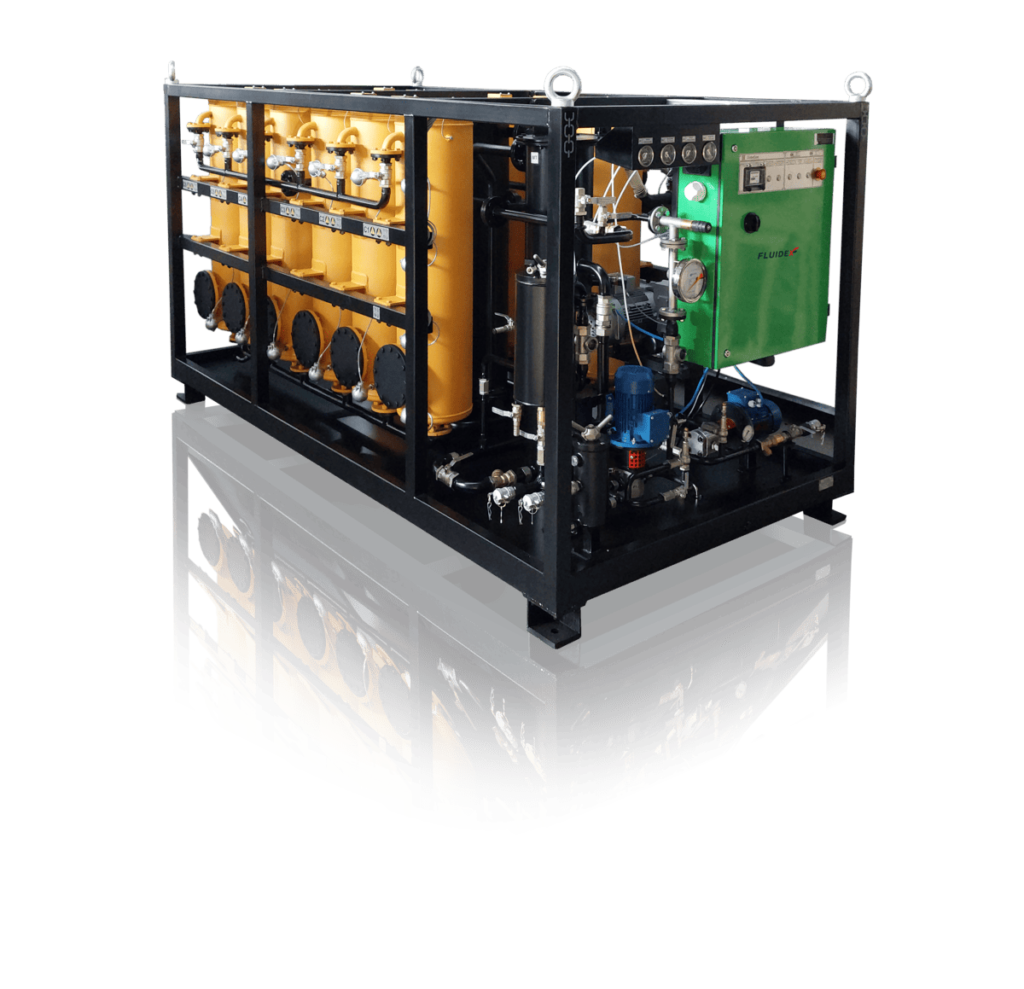
Fluidex has developed a highly effective transformer oil reclamation technology based on the use of Fuller’s Earth, implemented in its FLD-R oil reclamation plants. These systems feature a modular design, allowing them to be configured for full-scale restoration of oil properties.
The reclamation process starts in the reclamation unit, which contains several columns filled with Fuller’s Earth sorbent. As the oil flows through these columns, the Fuller’s Earth adsorbs acids, sludge, and oxidation byproducts, restoring the initial dielectric and physicochemical properties of oil.
This deep reclamation process helps addressing the following objectives:
- Reduction of the total acid number (TAN).
- Change of oil color from dark brown or cloudy to light yellow.
- Increase in breakdown voltage.
- Reduction of the dielectric dissipation factor (tan delta), among other benefits.
After the reclamation process, the oil passes through an inhibitor input unit, whereinto specifically formulated antioxidant additives are fed. These inhibitors slow the reoxidation process during subsequent operation, extending the effective service life of oil and maintaining its restored properties.
